Sedgwick Pie: A grave curiosity in Stockbridge, Massachusetts
New England cemeteries reside as solemn witnesses to the region's rich tapestry of history, serving as repositories of cultural heritage and architectural marvels. With their weathered gravestones and winding paths shaded by trees, these hallowed grounds offer a poignant glimpse into the lives of generations past. Beyond mere burial sites, these cemeteries serve as outdoor museums, chronicling the triumphs and tragedies of mortal souls. As guardians of remembrance, New England cemeteries play a vital role in preserving the collective identity of communities, ensuring that the legacies of the past endure for generations to come.
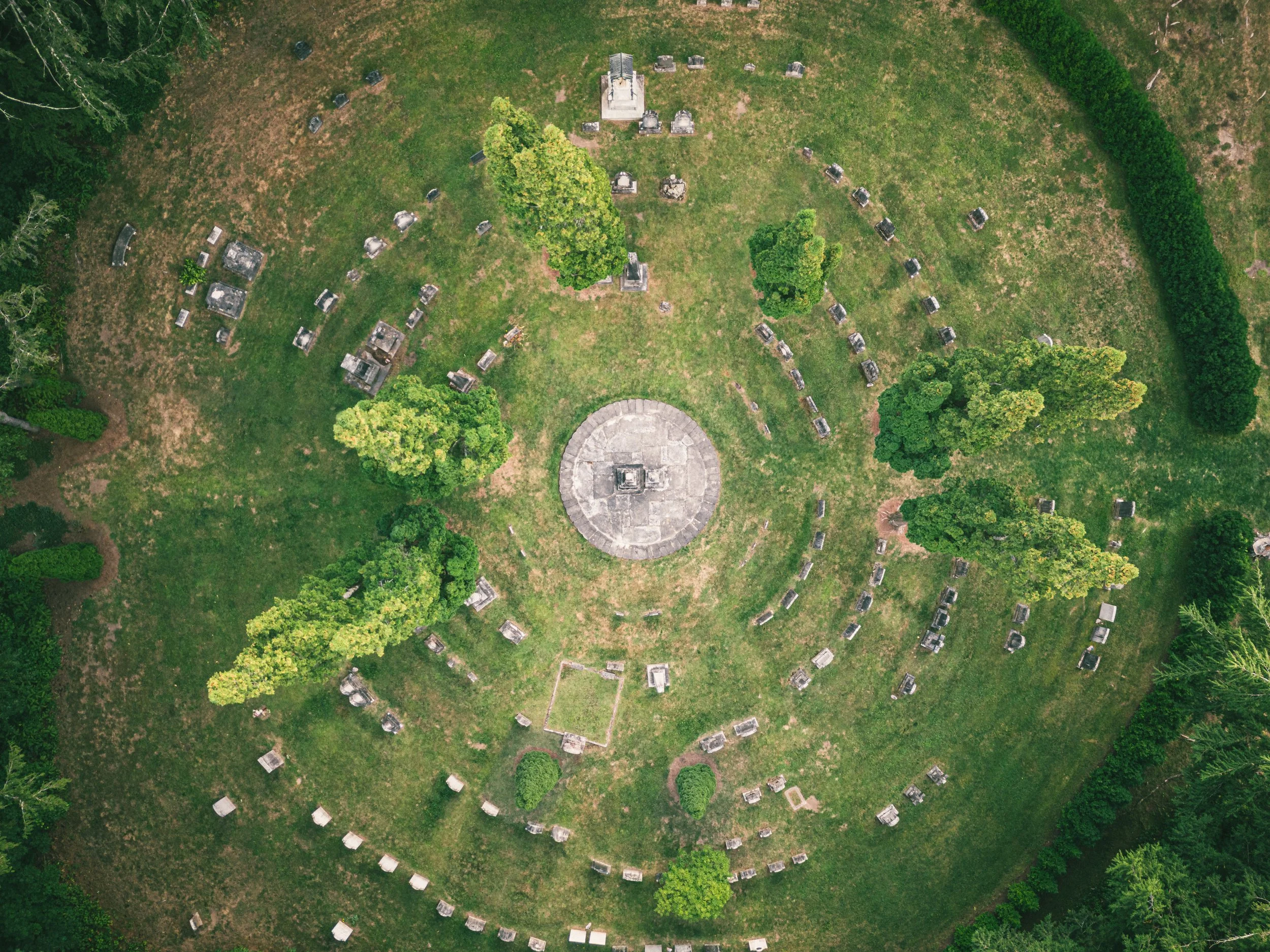
Stockbridge Cemetery dwells in the small bucolic town of Stockbridge, Massachusetts, holding more than two and a half centuries of history within its boundaries. Amidst the many gravestones sits a peculiar family cemetery plot veiled in a labyrinth of lore, bearing the name Sedgwick Pie. Its curious appellation comes from the unusual arrangement, which consists of more than 100 tombstones organized in concentric circles facing inward.
Who is the Sedgwick Family? The History of the Family Behind the Sedgwick Pie
The Sedgwick family occupies a prominent place in American history, with a legacy that spans generations and encompasses significant contributions to politics, law, and society. Their roots trace back to England, with the earliest known member of the Sedgwick family, Robert Sedgwick, arriving in Massachusetts Bay Colony in 1636 as part of the Great Migration. The Sedgwicks were known for their progressive views on social reform and abolitionism, but their legacy extends beyond politics, with several members making significant contributions to literature, art, and philanthropy. Today, the Sedgwick family continues to be celebrated for their enduring impact on American history and culture.
The History and Legend of the Sedgwick Pie Explained
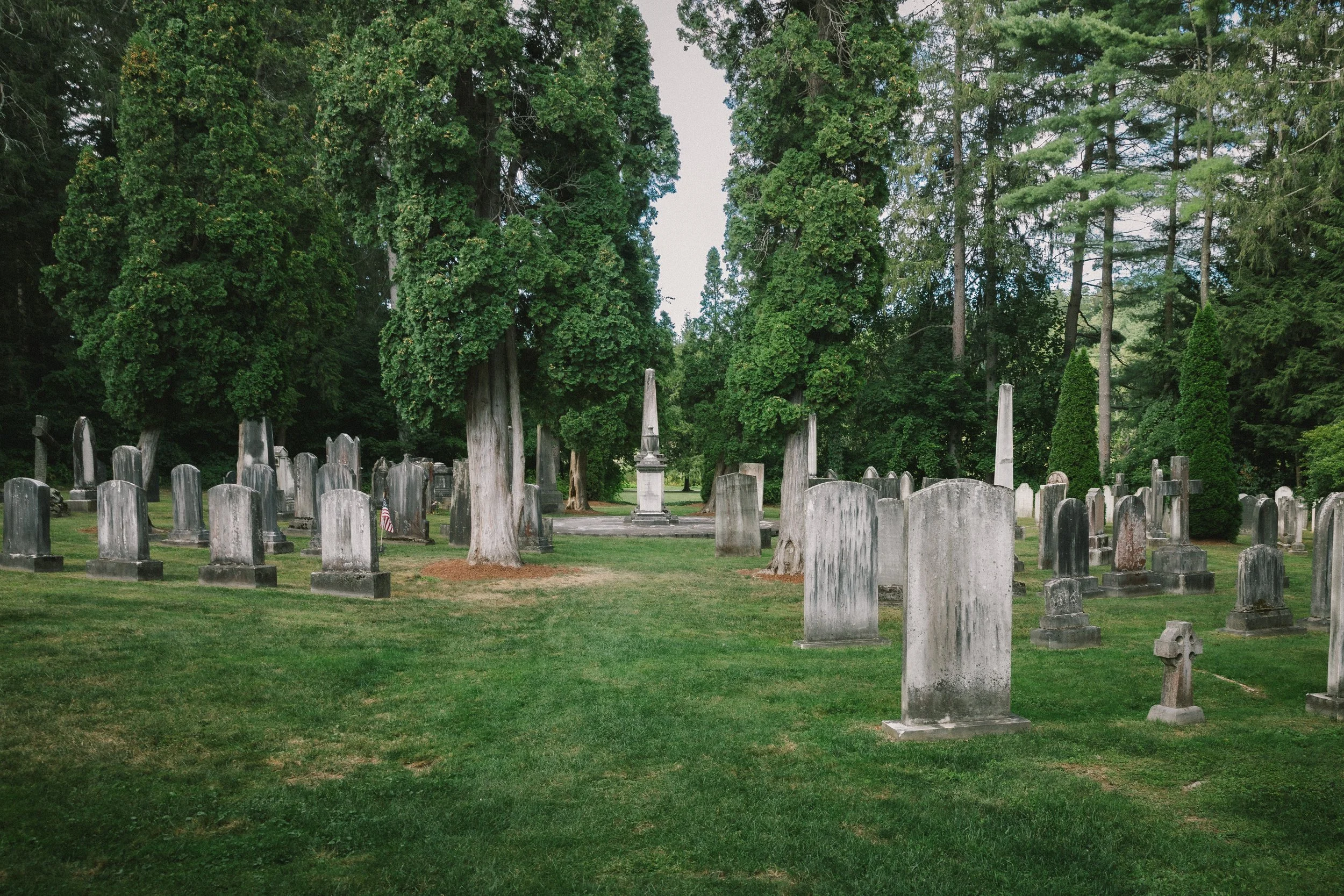
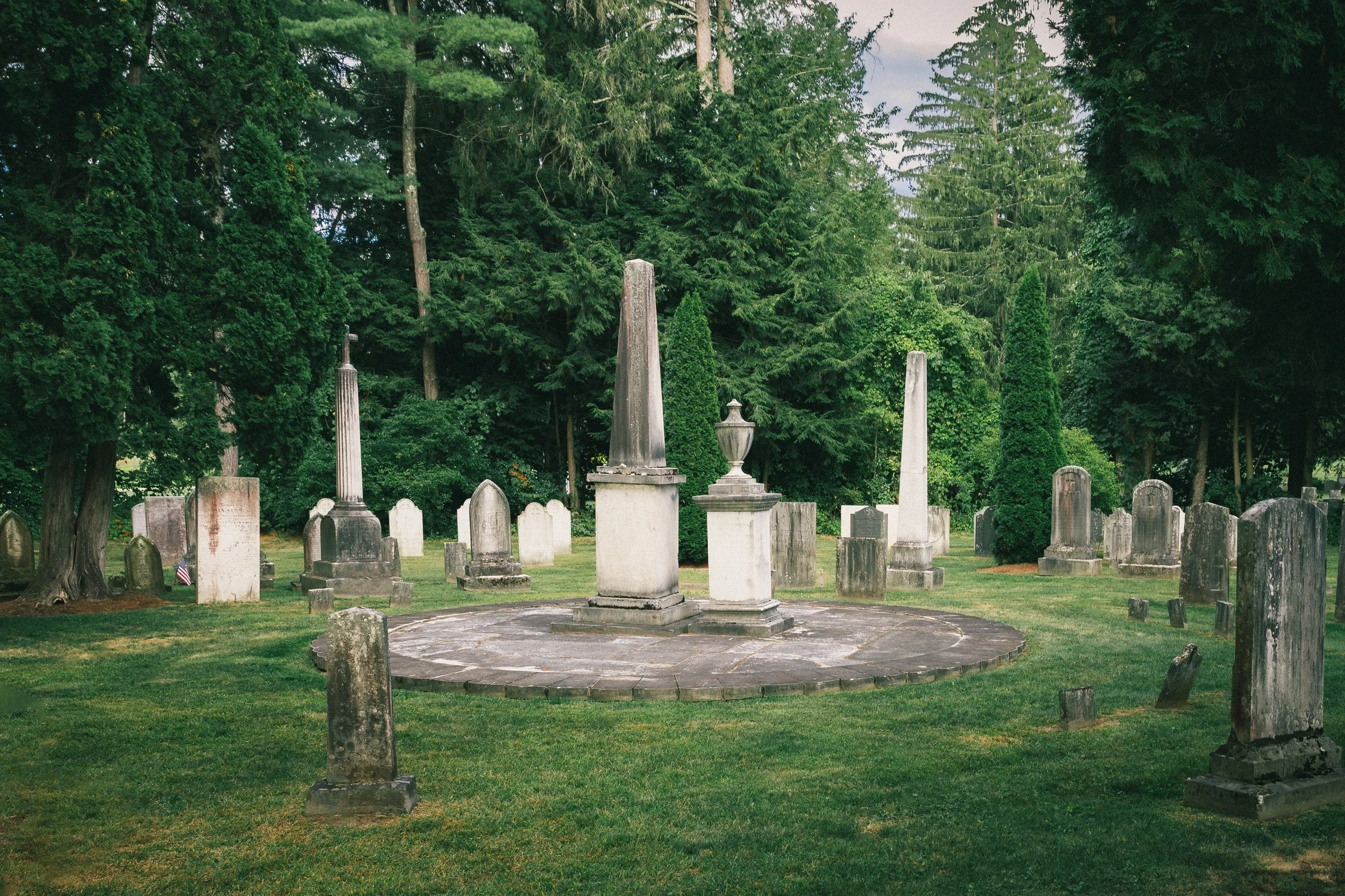
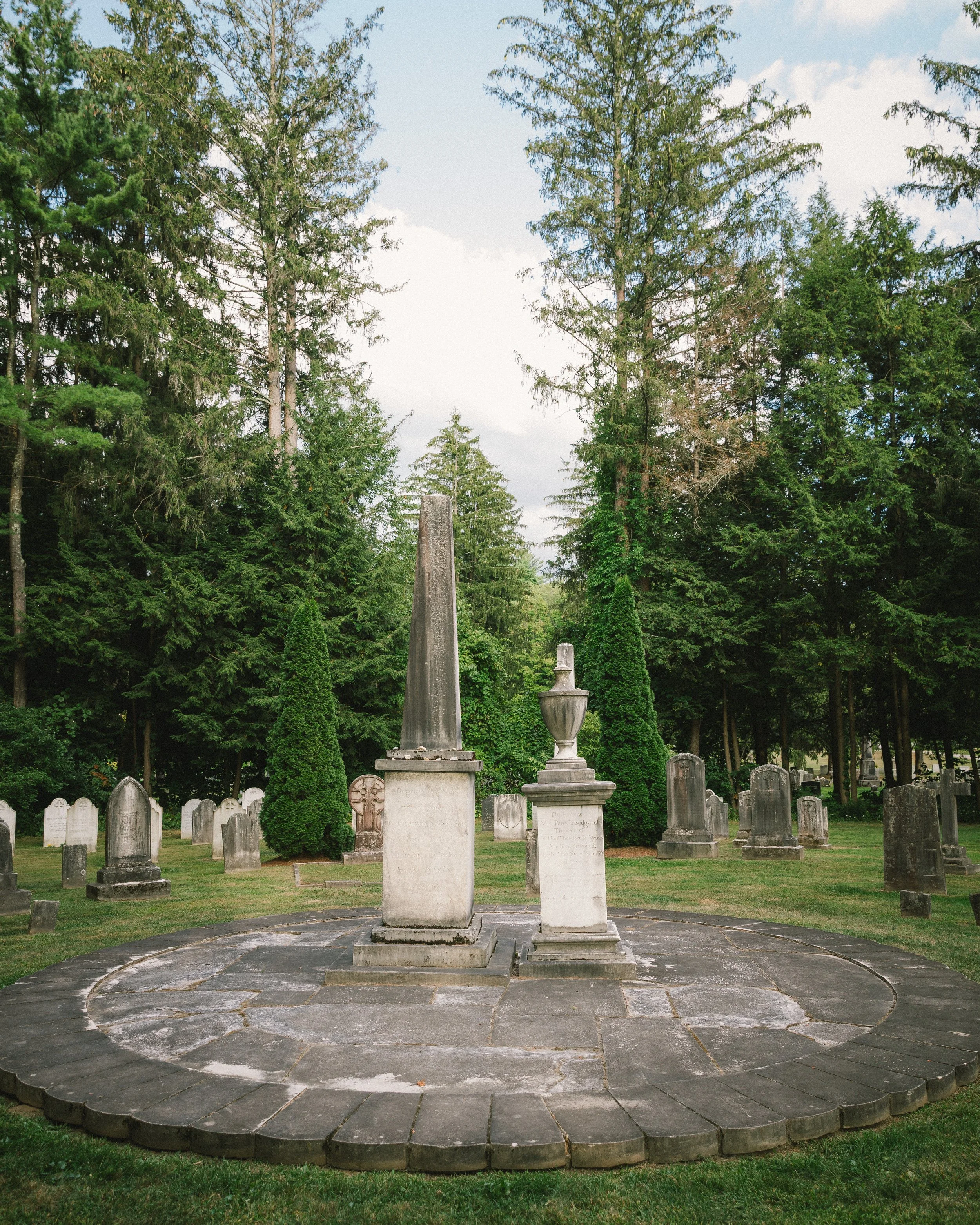
As far as I could find, the first mention of the Sedgwick Pie legend appears in the 1983 biography of Edie Sedgwick, Edie, An American Biography by Jean Stein, where the book opens with a vivid depiction of the unusual burial plot. At the center of the plot rests the first of the Stockbridge Sedgwicks, Judge Theodore Sedgwick, the patriarch of the family, with a ten-foot-high obelisk reaching for the sky. Buried along with him is his second wife, Pamela; her monument is a smaller one with an urn perched on top. The descendants of Judge Sedgwick are all buried in an idiosyncratic arrangement of concentric circles with their heads facing outward and their feet pointing toward the center like ripples of water radiating outward from a pebble tossed into a lake.
At first, just the seven children of Theodore and Pamela were buried around their parents in a semi-circle in the cemetery plot. Then, generation after generation followed. Today, the Sedgwick Pie contains more than 130 graves. Anyone who is a descendant of the Judge may be buried there, with few exceptions for close relatives of descendants, servants, and even family pets.
Although it’s not strictly followed, headstones in many cemeteries face east for practical and religious reasons. This tradition can be traced back to the ancient Egyptians and Greeks, who both worshipped a sun god. According to their beliefs, the dead should face the sun to greet each new day. Biblical scripture also contributed to the popularity of this practice among Christians, teaching that when Christ returns, it will be from the east. While this ideology may be antiquated, many graves continue to face this direction for both maintenance and aesthetic reasons.
According to the Sedgwick Pie legend, the reason for its distinctive design is that on Judgement Day, when they all rise, they will face their ancestors and have to see no one but other Sedgwicks. Although, according to John Sedgwick, this explanation of the layout does not originate from the family, but rather serves to disparage them. In 2023, the Berkshire Eagle reported that the design was actually the idea of Catharine, the daughter of Theodore and Pamela Dwight, and her siblings, who envisioned the concentric circles emanating outward, with each ring of graves representing a successive generation. Despite that explanation, the legend persists.
As for the nomenclature, it is rumored to have originated from Joseph Hodges Chote, whose estate, Naumkeag, was (and still is) located perched atop a hill right behind Stockbridge Cemetery.
Funeral Traditions, Family Lore, and the Strange Legacy of Stockbridge’s Most Famous Burial Plot
At least some of the Sedgwicks take the tradition of the Pie very seriously. According to one account, Minturn Sedgwick wrote a letter to the Selectmen of Stockbridge in 1971 asking that they return some land next to the Pie, which had previously been donated to the community. He was concerned that by the year 2101, the plot would be too overcrowded and they would have nowhere to go if no more land were made available. Allegedly, the Selectman responded to Minturn’s letter and let him know that his concern seemed premature since that was well over a century away.
The Sedgwicks were once known for a distinctive set of funeral customs. According to family tradition, the coffin was draped with a deep purple pall and carried in an open cart rather than a hearse. Drawn by a black horse and adorned with hemlock and white lilacs, the cart led a procession of mourning family members and friends, who followed behind on foot. As the cortege passed the Sedgwick house, it paused briefly for a moment of silence before continuing to the cemetery.
A few days after the televised funeral of President John F. Kennedy, John P. Marquand Jr., whose mother, Christina Sedgwick, connected him to the family, received an unusual letter from Minturn Sedgwick. Minturn explained that he had heard from his cousin Charles Sedgwick, who had occasionally interpreted French for Kennedy, that the President was familiar with the legend of the Sedgwick Pie. This led Minturn to a curious theory: had Jacqueline Kennedy "borrowed" elements of the family's funeral traditions for the president's funeral, including the horse-drawn cart and mourners following behind on foot? Eager for an answer, Minturn enclosed a self-addressed stamped postcard and asked John for his thoughts. Amused by the inquiry, John showed the letter to his aunt, who declared that it ought to be burned.
Minturn’s commitment to these traditions extended to the coffins in which the family would be buried. Preferring simple pine box coffins to ornate caskets, he reportedly purchased a supply for the family from a manufacturer in Pittsfield. According to family accounts, he was so committed to the idea that he climbed into the coffins himself to ensure they were large enough to accommodate his broad shoulders.
Over time, stories such as these have become woven into the lore of the Sedgwick Pie, helping to transform a family burial plot into a place of curiosity and legend. Yet the Pie's enduring fascination rests not only in its traditions, but in the storied lives commemorated by its gravestones.
Prominent Individuals Interred in the Sedgwick Pie Burial Plot
Theodore Sedgwick: The Man at the Center of the Sedgwick Pie
Before he became the center of one of the most unique cemetery plots in Massachusetts, Theodore Sedgwick was born the fourth child of Deacon Benjamin and Ann Thompson Sedgwick in West Hartford, Connecticut, on May 9, 1746. He went on to attend Yale, where he studied theology and law, although he never graduated; it was not the end of his journey to become a lawyer. Theodore continued to study the law through an apprenticeship under an attorney named Mark Hopkins in Great Barrington, Massachusetts, and was admitted to the bar in 1766 before opening his own practice there.
In the late 1700s, after the British Empire gained dominance in North America following the success in the Seven Years’ War, tensions between the Thirteen Colonies and Britain were mounting. This escalated even further after the passage of the unpopular Stamp and Townshend Acts, attempts by Britain to impose economic control over the colonies. As these tensions continued to mount, Theodore became increasingly involved in the revolutionary cause. In 1774, as secretary to the Berkshire County committee, he helped draft the Berkshire Covenant, a call for peaceful resistance to British authority. Then, during the Revolutionary War, he served on the staff of General John Thomas during the campaign to reinforce the siege of Quebec and later took on the role of commissary for the northern Continental Army, helping secure the food and supplies needed to sustain the troops.
As a young lawyer in 1781, Theodore, along with fellow lawyer Tapping Reed, pleaded the historic freedom suit of Bromm and Bett vs Ashley in the County Court in Great Barrington. Freedom suits were lawsuits in the Thirteen Original Colonies filed by slaves against their slaveholders to challenge slavery both directly and indirectly. This case set a precedent in the state of Massachusetts based on the ruling that slavery was irreconcilable with the new state constitution of 1780. These codes also enabled enslaved persons to sue for freedom based on wrongful enslavement. This particular case was cited in the appeal of the more well-known case, Quock Walker v. Jennison, heard in the Massachusetts Supreme Judicial Court, which ended slavery in the state. It is worth noting, however, that according to research conducted by both The Washington Post and the Massachusetts Historical Society, Theodore Sedgwick owned at least one slave; a copy of a bill of sale in possession of the Massachusetts Historical Society shows Theodore Sedgwick purchased an enslaved woman named Ton from General John Fellows. Theodore eventually moved his law practice to nearby Stockbridge in 1785 and built the family house that would be known as the Sedgwick Mansion.
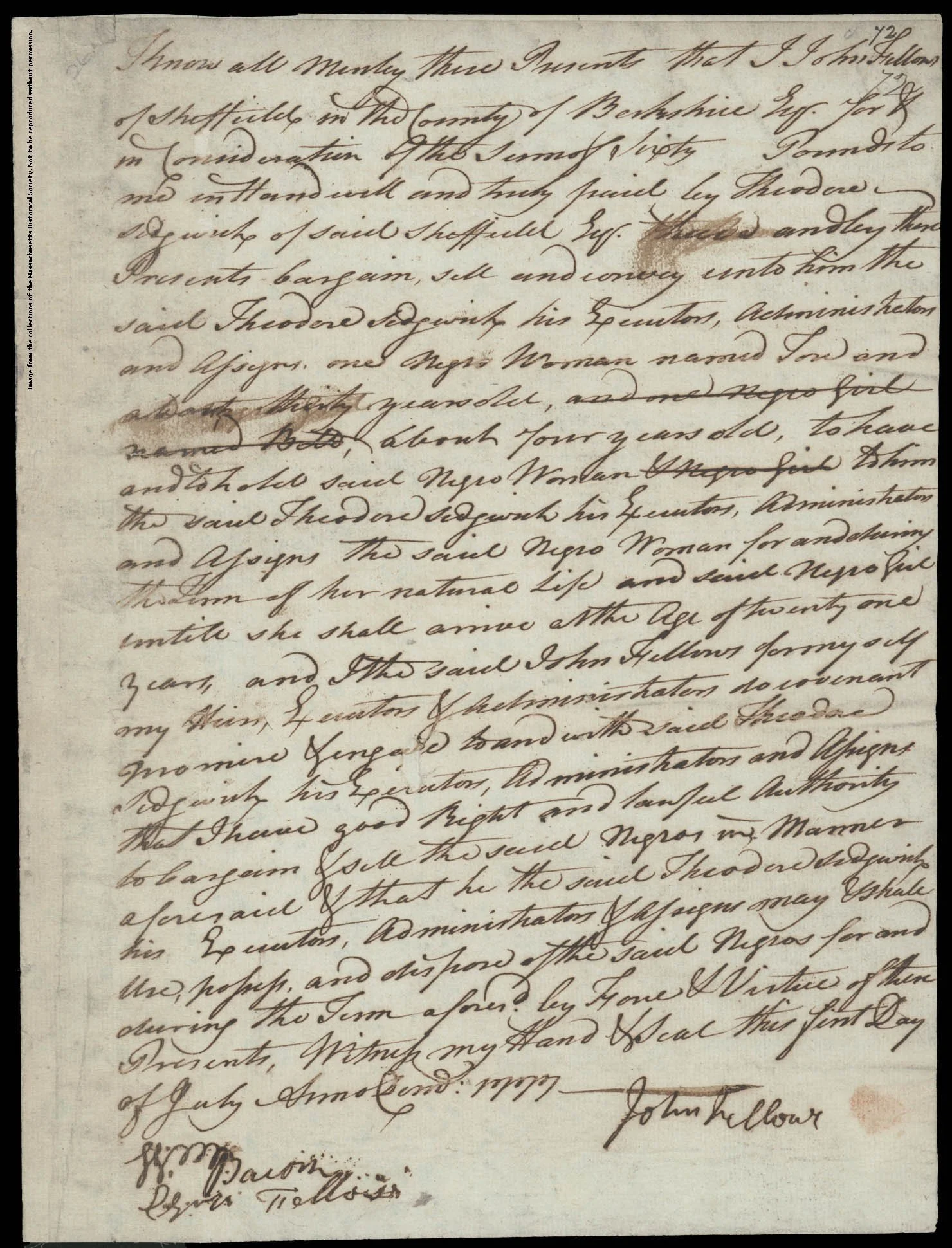
Bill of sale from John Fellows to Theodore Sedgwick for Ton (an enslaved person), 1 July 1777 from the Sedgwick family papers, Massachusetts Historical Society
Theodore's political career continued to expand in the years following the American Revolution, solidifying him as one of the most influential political figures in early Massachusetts. He served in the Massachusetts legislature and represented the state in the Continental Congress from 1785 to 1786. During Shays' Rebellion in 1787, he was a vocal opponent of the uprising, a position that made him a target of threats and even attacks on his home.
He went on to serve in the First Federal Congress in 1789 and would spend much of the next decade in national office. A committed Federalist, he served in both the House and Senate before returning to the House as Speaker from 1799 to 1801. Near the end of his career, he was appointed to the Massachusetts Supreme Judicial Court by the Governor of Massachusetts, a position he held until he died in 1813.
Additionally, Theodore Sedgwick served as a political ally to both Alexander Hamilton and George Washington. In fact, Alexander Hamilton penned him a letter a mere few hours before his renowned duel with Aaron Burr, expressing his deep concerns over the future of the republic and democracy. It was the last letter he ever wrote.
Theodore was married a total of three times during his life. His first wife, Eliza Mason, passed away within a year of their marriage around 1771. He married Pamela Dwight three years later, who was the mother of his ten children, three of whom died within a year of their birth. After extensive struggles with mental illness, Pamela died in 1807. Then, just eight months after her death, he announced his intention to marry Penelope Russell. This caused a lot of strife in the family, as the children were horrified and upset at the prospect of their father marrying another woman so soon after their mother’s death, especially one that they thought was just after the family fortune. Against their wishes, Theodore married Penelope in November of 1808. They remained married until his death.
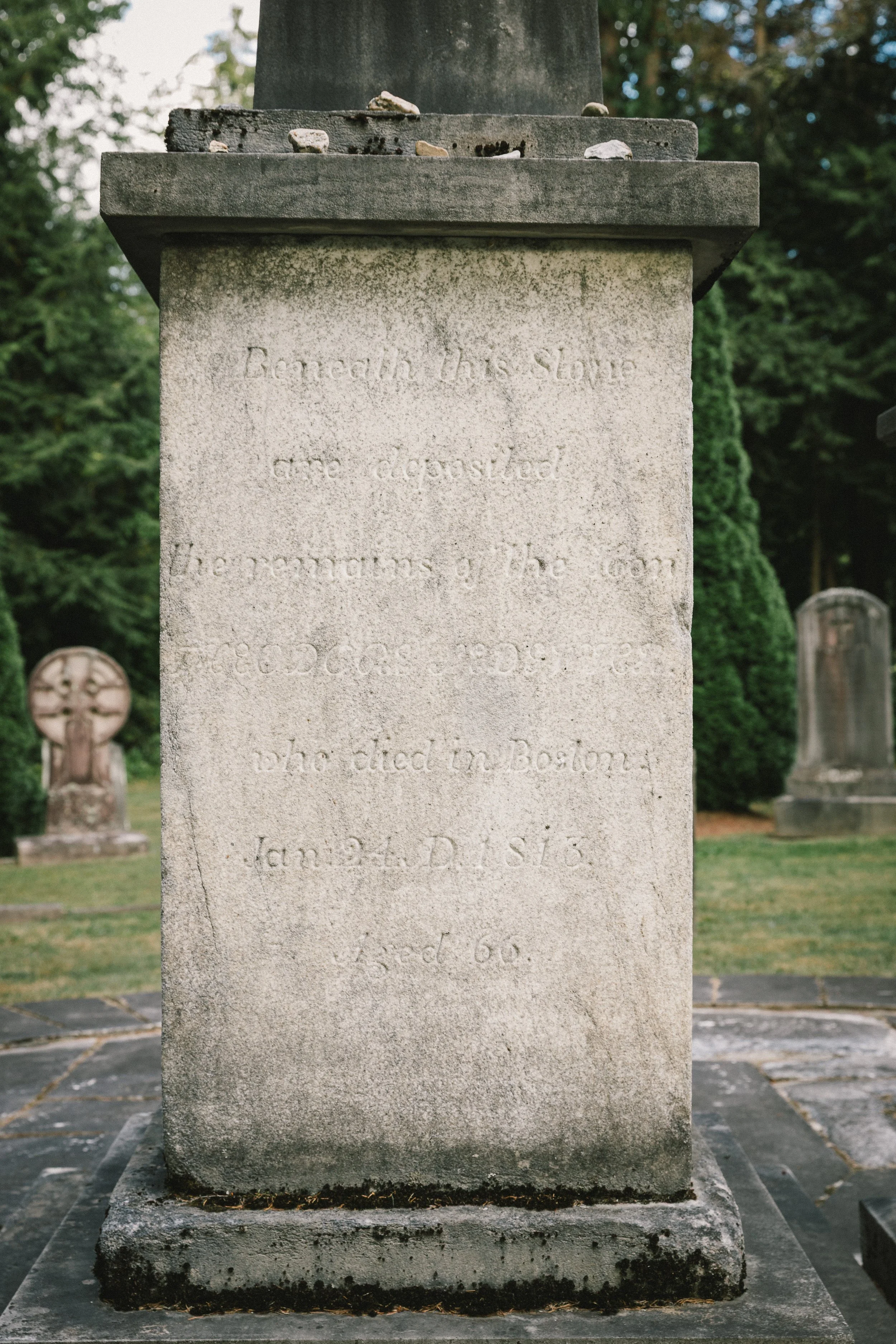
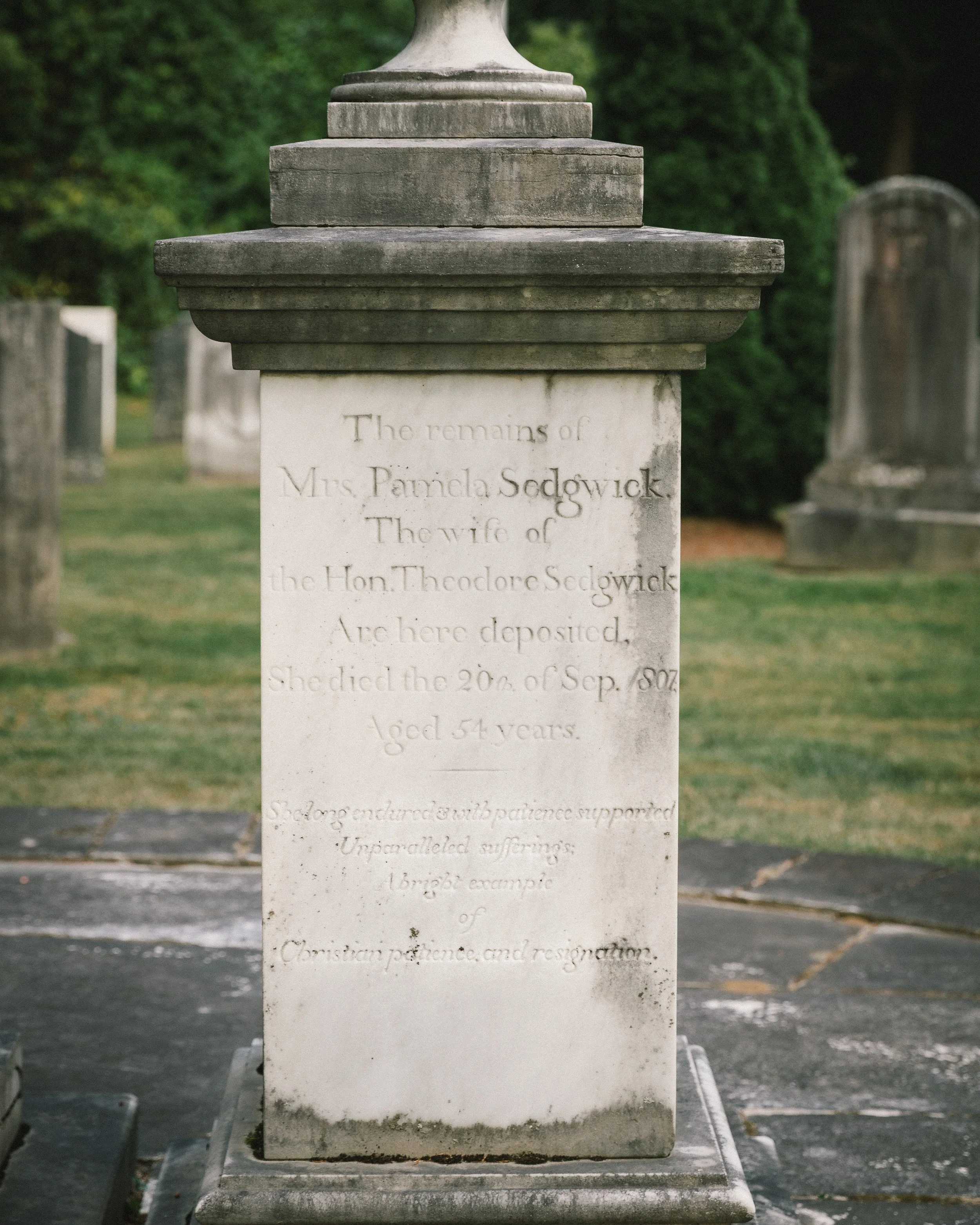
Theodore was originally buried in the Granary Burying Ground in Boston, the final resting place of Paul Revere, the five victims of the Boston Massacre, and several signers of the Declaration of Independence, among others. A short time later, his children, afraid he would be forgotten, hired gravediggers and had Theodore exhumed and brought back to Stockbridge by horse-drawn carriage, where they had purchased a large plot in Stockbridge Cemetery. At Catharine’s insistence, they also unearthed their mother Pamela’s casket, which was just a few hundred feet away, and had her reburied with him, reuniting them once again after so many decades apart.
Pamela Dwight Sedgwick: Life, Mental Illness, and a Mysterious Death
Beside Theodore's grave rests his wife, Pamela Dwight Sedgwick. The couple married in April 1774, when Pamela was not yet twenty-one years old. In the years that followed, Theodore's legal and political career flourished, and their family grew alongside his success. Over the course of their thirty-three-year marriage, Pamela gave birth to ten children, seven of whom survived to adulthood. Yet the demands of Theodore's public life came at a personal cost. His frequent absences, combined with the heartbreak of losing three children, placed a tremendous strain on Pamela's physical and emotional well-being. Some historians have even suggested that she was among the first American political wives to bear the burdens and sacrifices that accompanied a husband's public career.
Theodore's public duties frequently kept him away from home for weeks or even months at a time, requiring travel to Boston, New York, and later Philadelphia. These absences often coincided with long New England winters and the anniversaries of the deaths of the couple's three infant children, leaving Pamela to manage the household and care for their surviving children on her own. Despite these hardships, she remained steadfast in her support of her husband's career. Following the death of Pamela’s mother in 1791, however, her emotional struggles deepened, particularly during Theodore's prolonged absences.
Pamela experienced her first major episode of mental illness in late 1791 while preparing for the birth of her tenth and final child. At the time, Theodore was attending a session of Congress and was unable to return home for the delivery. In his absence, friends and household servants came to her aid. The episode marked the beginning of a recurring pattern that would continue throughout the remainder of her life. During these periods of illness, friends and relatives in the Berkshires often gathered to assist in her care, while maintaining a steady correspondence with Theodore in the nation's capital. In their letters, Theodore expressed his worry and distress, while those caring for Pamela frequently reassured him that his public duties remained too important to abandon.
In December 1795, Pamela suffered another serious episode and was placed in seclusion under the care of a physician while Theodore remained in Philadelphia. Throughout her illness, her half-brother visited frequently and repeatedly assured Theodore that there was no need for him to return home. When Theodore finally arrived back in Stockbridge the following June, Pamela returned as well. By the end of the summer, her family believed she had fully recovered.
Throughout these years, Theodore repeatedly assured Pamela that he had devoted enough of his life to public service and would soon spend more time with his family. Yet those promises never came to fruition. Although Pamela expressed understanding and support for her husband's ambitions, she continued to hope that each new chapter of his career might be his last. Instead, Theodore's political responsibilities continued to keep him away from home for extended periods, and the couple relied heavily on letters to maintain their connection.
In late November 1799, Theodore traveled to Philadelphia for the first session of the Sixth Congress, where he was elected Speaker of the House. Meanwhile, Pamela continued to struggle with recurring episodes of illness. When Theodore declined to seek reelection in 1800, she had reason to hope that the long years of separation and isolation were finally drawing to a close. Yet although his congressional career ended, his public life did not. His duties continued to take him away from Stockbridge, particularly to Boston, while Pamela's condition steadily worsened in the years that followed, often becoming especially severe during the winter months. At one point, Theodore considered resigning his judgeship in order to devote more time to his wife and family, but ultimately chose to remain in public service.
By the end of 1806 and into the early months of 1807, Pamela's condition appeared to have improved considerably. To her family, it may have seemed that the long cycle of illness and suffering was finally coming to an end. Instead, the recovery was only a brief reprieve. Before the leaves had fallen in the autumn of 1807, Pamela would be dead.
The circumstances surrounding Pamela Dwight Sedgwick's final days remain somewhat unclear. According to John Sedgwick's 2007 memoir, In My Blood: Six Generations of Madness and Desire in an American Family, Elizabeth Freeman discovered a bruise near Pamela's eye on the morning of September 19, 1807, suggesting that she may have struck her head during the night. After lunch, Pamela retired to her bedchamber, complaining of fatigue. Later that evening, as a friend sat with her upstairs, the Sedgwick family gathered below in the parlor and made what was described as a considerable amount of noise. Concerned that the commotion might disturb the ailing woman, Pamela's companion voiced her worries. Instead, Pamela spoke what would become her last coherent words, remarking that the sound of her children enjoying themselves filled her with delight.
Sometime during the night, the household was startled awake by loud groans coming from Pamela's room. When family members rushed to investigate, they found her on the floor in obvious distress, thrashing violently and struggling for breath. Later accounts suggest that poison may have been involved, though the exact circumstances remain uncertain. Some have speculated that Pamela may have taken an insufficient dose of poison the previous night, resulting in the fall that caused the bruise Elizabeth Freeman discovered that morning. Others have suggested that the injury may have been self-inflicted. Whatever transpired, her condition rapidly deteriorated. By dawn, it was clear that Pamela was dying, and the family sent for Theodore in Boston. He was unable to return before she passed away.
The circumstances surrounding Pamela's final illness and death were rarely discussed within the family, and they appear only sparingly in surviving correspondence, contributing to the uncertainty that later developed around her final days.
Theodore returned to Stockbridge two days later, and a funeral was held shortly thereafter. Pamela was initially buried in the Dwight family plot in Stockbridge Cemetery. Like her husband, she was later disinterred and moved to the center of the Sedgwick Pie, where she was ultimately laid to rest alongside him.
Her epitaph reads:
She long endured and with patience supported
Unparalleled sufferings:
A bright example
Of
Christian patience and resignation
Catharine Sedgwick: Life, Literary Career, and Her Connection to Elizabeth Freeman
Catharine Sedgwick was born in Stockbridge in December 1789, the sixth child and third daughter of Theodore and Pamela Dwight Sedgwick. Owing in part to her mother's ongoing physical and mental health struggles, much of Catharine's early care fell to Elizabeth Freeman. The relationship left a lasting impression on her. Throughout her autobiography, Catharine frequently recalled Elizabeth and reflected on the profound influence she had on her character, values, and understanding of the world.
Catharine received her education at local district schools in Stockbridge before continuing her studies at boarding schools in Albany and Boston. Following the death of her father, she developed a deeper interest in religion and eventually embraced Unitarianism, departing from the Calvinist faith in which she had been raised. Her opposition to religious intolerance inspired her to write a pamphlet on the subject, which she later expanded into her first novel, A New-England Tale. Published anonymously in 1822, the book was warmly received and marked the beginning of a remarkable literary career.
Over the following decades, Catharine cemented her reputation as one of America's most well-known women and celebrated authors at the time with works such as Redwood (1824), Hope Leslie (1827), Clarence; or, A Tale of Our Own Times (1830), and The Linwoods; or, "Sixty Years Since" in America (1835). By the height of her career, she was among the best-known women writers in the United States. Her final novel, Married or Single?, was published in 1857. Contemporary accounts also describe Catharine as a gracious hostess who welcomed many of the leading literary figures of her day, including Herman Melville and Nathaniel Hawthorne, to gatherings at her home.
Beyond her literary career, she was actively involved in several reform causes, including the abolitionist movement, the Unitarian church, and the Women's Prison Association. Her advocacy was also shaped by personal experience. Having witnessed the struggles of both her mother, Pamela, and her brother Henry Dwight Sedgwick, she developed a particular interest in mental health and the treatment of those suffering from mental illness. Catherine also assisted her sister-in-law with running a school in nearby Lenox.
Throughout her life, Catharine remained deeply devoted to her siblings and their families, maintaining close relationships throughout her life. She also traveled extensively, journeying throughout the United States, Canada, and Europe, experiences that broadened her perspective and informed her writing. Although she was once engaged to Harmanus Bleecker and received several other proposals over the years, Catharine ultimately chose not to marry. Instead, she dedicated herself to her family, her literary pursuits, and the causes she championed. For much of her adult life, she divided her time among relatives in New York City, Lenox, and Stockbridge.
Catharine died in July 1867 at "Woodbourne," the West Roxbury home of her niece, Katharine Sedgwick Minot. She was seventy-seven years old.

Elizabeth Freeman: The Enslaved Woman Who Helped End Slavery in Massachusetts
Among those buried in the Sedgwick Pie, Elizabeth Freeman stands apart. She was not a Sedgwick, but her life became deeply intertwined with the family’s history—and with the history of freedom in Massachusetts. Unable to read or write, Freeman left behind no written account of her own life. Much of what is known about her has instead been reconstructed through historical records and the later writings of Catharine Sedgwick.
Born into slavery around 1744 on the New York farm of Pieter Hogeboom, she was given the name Bet, later known as Mumbet. When Hogeboom’s daughter married John Ashley of Sheffield, Massachusetts, he transferred Bet, then about seven years old, to the newly married couple. Her experience was part of a broader system. In eighteenth-century Massachusetts, slavery was deeply embedded in the colony’s economy and domestic life, and many white colonists took advantage of forced and unpaid labor.
Catharine Sedgwick’s account of Elizabeth Freeman’s life preserves several stories from the roughly thirty years she was enslaved by the Ashley family. Freeman likely spent much of that time performing unpaid domestic labor within the household: cooking, cleaning, spinning, sewing, tending fires, and caring for others as a nurse and midwife. Later accounts portray the Ashleys, particularly Hannah Ashley, as cruel, and one of the most enduring stories of Freeman’s life centers on an act of violence in the Ashley kitchen.
According to these accounts, Hannah Ashley discovered another enslaved person making bread from leftover dough. Sources differ on that person’s identity; some describe her as Freeman’s daughter, while others identify her as her sister. Enraged, Hannah seized a heated kitchen shovel and attempted to strike her. Freeman intervened, and the blow landed on her instead, leaving a severe wound on her arm. As the injury healed, she reportedly refused to cover the scar, choosing instead to leave it visible as a reminder of the abuse she had endured.
In 1773, John Ashley hosted the committee that drafted the Sheffield Resolves, a declaration of grievances against British rule. Though Bet could not read or write, later accounts recall that she repeatedly overheard one of its central assertions: that all people were born “equal, free and independent of each other” and entitled to the undisturbed enjoyment of life, liberty, and property.
When similar language appeared in the Massachusetts Constitution of 1780, Freeman recognized its significance. She sought the counsel of Theodore Sedgwick, who, together with Tapping Reeve, brought her case before the Berkshire County Court of Common Pleas. In April 1781, Theodore Sedgwick argued that slavery was incompatible with the new state constitution. The court ruled in her favor that August, awarding her freedom and damages. John Ashley began an appeal to the Massachusetts Supreme Judicial Court but later abandoned it. This case was unlike previous freedom suits, as it made no claim that John Ashley had violated a law, but instead directly challenged the existence of slavery in Massachusetts.
The case secured her own freedom and became an important legal precedent in the series of cases that brought slavery to an end in Massachusetts. Once free, she chose the name Elizabeth Freeman and made her home in Stockbridge for the rest of her life.
Some accounts state that John Ashley offered Elizabeth Freeman paid work after her emancipation, but she declined and instead entered the household of Theodore Sedgwick in 1790. It was here she garnered their nickname “Mumbet,” combining “mum,” referring to the variant spelling of mom as a term of respect, with her previous name, Bet.
In the years after securing her freedom, Freeman built a life of remarkable independence in Stockbridge. She became one of the first women in Massachusetts known to own property, purchasing nineteen acres of land on a hill overlooking the village, where she built a house and established a small farm where she would raise her family.
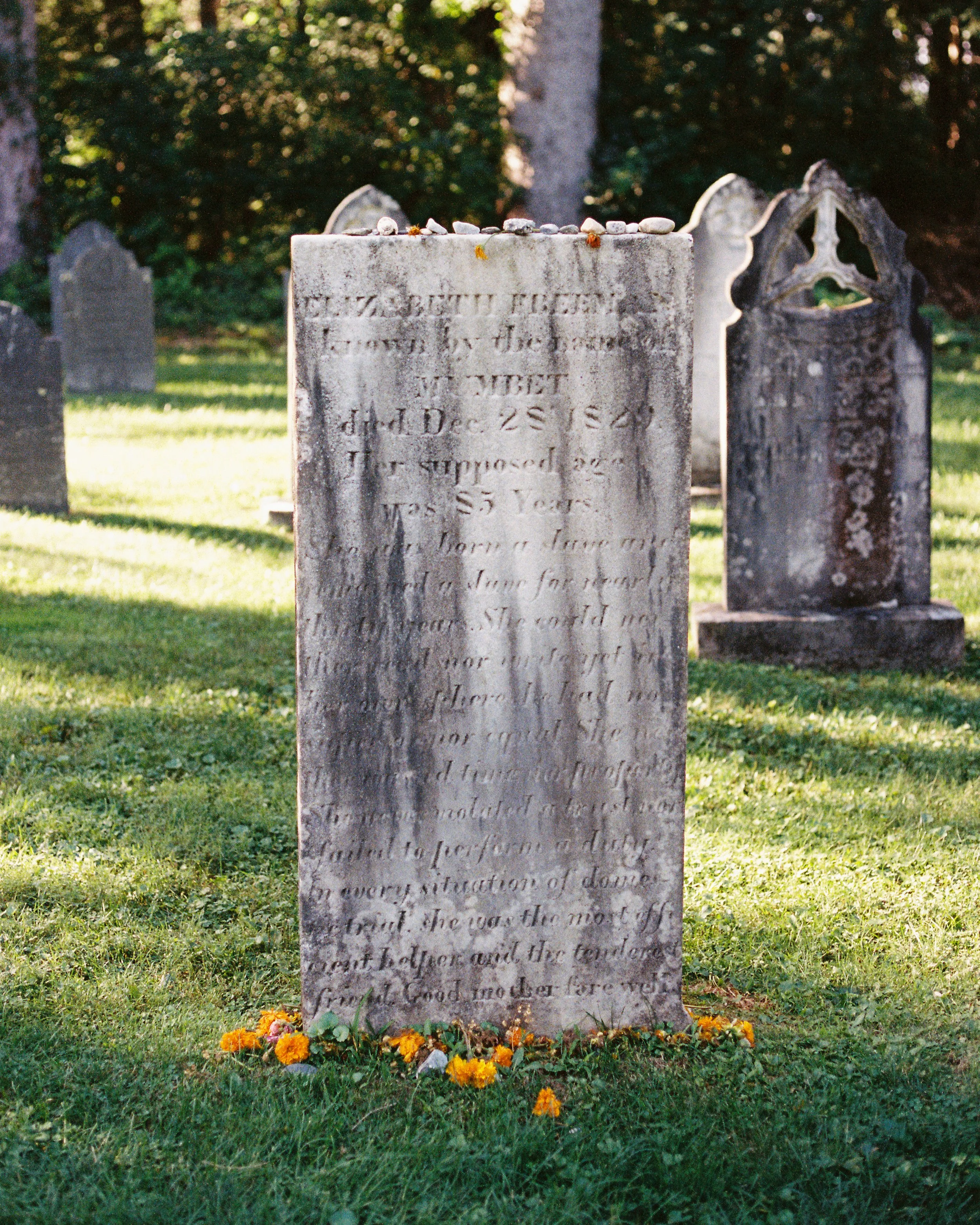
Elizabeth Freeman died in December 1829 at about eighty-five years old. In her will, she left the greater part of her possessions to her daughter, grandchildren, and great-grandchildren. She was buried beside Catharine Sedgwick in the Sedgwick Pie, the only person interred there who was not connected to the family by blood or marriage.
Her burial among the Sedgwicks can be read by some as a moving testament to the place she held within the family. Yet it also carried a painful consequence for her own descendants. Because the plot was reserved for the Sedgwick family, she would forever be separated from them, as now, they could not be buried alongside her.
Her epitaph reads:
Elizabeth Freeman
Known by the name of Mumbet
Died Dec 28th 1829
Her supposed age was 85 years
She was born a slave & remained a slave for nearly thirty years. She could neither read nor write yet in her own sphere she had no superior or equal. She never violated a trust nor failed to perform a duty. In every situation of domestic trial she was the most efficient helper & tenderest friend. Good Mother farewell!
Elizabeth Freeman’s legacy continues to be honored throughout Massachusetts. Each year on August 21, the anniversary of the 1781 judgment that secured her freedom, the state observes Elizabeth Freeman Day. Her story is also preserved through an exhibit at the Ashley House in Sheffield, while the Elizabeth Freeman Center, a Berkshire County organization serving survivors of domestic violence and sexual assault, adopted her name after the Women’s Services Center and Rape Crisis Center merged in 1997. In 2022, a bronze statue of Freeman was installed on the Sheffield Green, creating a lasting public memorial to her life and legacy.
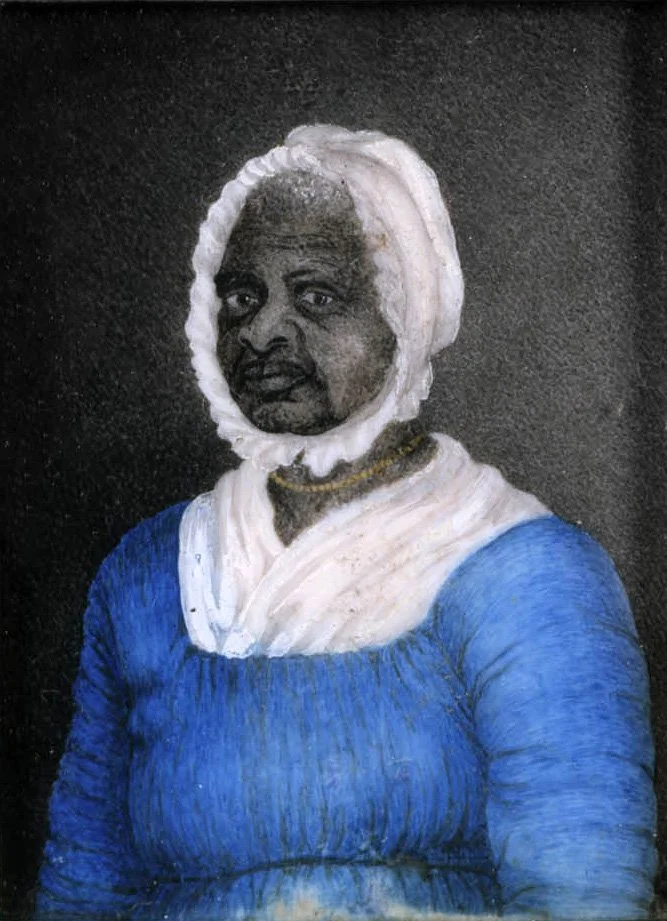
‘Mumbet.’ painted by Susan Anne Livingston Ridley Sedgwick, 1811. Watercolor on ivory. Photo courtesy of Massachusetts Historical Society, Boston. Licensed under Public domain via Wikimedia Commons.
More than two centuries after the inception of The Sedgwick Pie, visitors continue to wander amid the curious circles of gravestones that sit as an amalgam of the gripping tales of the lives of the humans buried there. Among them are political figures, authors, scholars, and soldiers. But also buried there is a courageous woman who was born a slave and died as one of the people integral to the abolition of slavery in Massachusetts. Perhaps that is what makes the Sedgwick Pie so enduring. More than a family cemetery plot, the Sedgwick Pie stands as a record of the ambitions, triumphs, tragedies, and courage that helped shape both a family and a nation.
-
Articles and websites:
The Trustees of Reservations. (n.d.). Ashley House.https://thetrustees.org/place/ashley-house/
Elizabeth Freeman Center. (n.d.). Elizabeth Freeman.https://elizabethfreemancenter.org/who-we-are/elizabeth-freeman/
Massachusetts Historical Society. (n.d.). Catharine Maria Sedgwick papers, 1803–1867.https://www.masshist.org/collection-guides/view/fa0357
Massachusetts Historical Society. (n.d.). Sedgwick family papers, 1717–1946.https://www.masshist.org/collection-guides/view/fa0248
Bellow, H. (2024, February 11). Theodore Sedgwick: The Berkshire founder who loathed democracy and helped save it. The Berkshire Eagle.https://www.berkshireeagle.com/history/theodore-sedgwick-the-berkshire-founder-who-loathed-democracy-and-helped-save-it/article_e5d0f451-2f5c-43b0-be71-6ca574fee7f9.html
Kaufman, J. (2023, November 3). Where to bury future generations? With the Sedgwick Pie running out of room, Stockbridge's most famous family faces a troubling question. The Berkshire Eagle.https://www.berkshireeagle.com/arts_and_culture/berkshirelandscapes/sedgwick-pie-family-cemetery-is-running-out-of-room-for-future-generations/article_e1a6b97a-750b-11ee-a09e-77a6177f3dbd.html
Encyclopaedia Britannica. (n.d.). Catharine Maria Sedgwick. Britannica.https://www.britannica.com/biography/Catharine-Maria-Sedgwick
Goldscheider, E. (2005, November 6). Stockbridge stoutly savors being small. The Boston Globe.https://archive.boston.com/travel/articles/2005/11/06/stockbridge_stoutly_savors_being_small/
Sedgwick, D. (n.d.). The Sedgwick family plot in Stockbridge, Massachusetts. Sedgwick.org.https://www.sedgwick.org/na/library/cemetery/ma.berkshire.stockbridge/SedgwickStockbridgePlot.html
Freeman, S. (n.d.). Sedgwick Pie. Elizabeth Freeman: Mumbet.https://elizabethfreeman.mumbet.com/sedgwick-family/sedgwick-pie/
Congressional Cemetery. (2022, August 22). Why do so many headstones face east?https://congressionalcemetery.org/blog/why-do-so-many-headstones-face-east/
Massachusetts government. “Massachusetts Constitution and the Abolition of Slavery.” Mass.gov, https://www.mass.gov/guides/massachusetts-constitution-and-the-abolition-of-slavery
Books:
Sedgwick, John. (2008). In my blood: Six generations of madness and desire in an American family. Harper Perennial.
Dwight, Benjamin Woodbridge (1874). The History of the Descendants of John Dwight, of Dedham, Mass. Vol. 2. J. F. Trow & Son, Printers and Bookbinders.
Woelfle, Gretchen. (2014). Mumbet's declaration of independence. Carolrhoda Books.
Zilversmit, Arthur. (1968). Quok Walker, Mumbet, and the abolition of slavery in Massachusetts. The William and Mary Quarterly, 25(4), 614–624. https://doi.org/10.2307/1916801
Stein, Jean. (1982). Edie: An American biography (G. Plimpton, Ed.). Alfred A. Knopf.
Kenslea, Timothy (2006). The Sedgwicks in Love: Courtship, Engagement, And Marriage in the Early Republic. University Press of New England.
Hart, John Seely (1857). The Female Prose Writers of America (Public domain ed.). E. H. Butler.
Sedgwick, C. M. (1872). Life and letters of Catharine M. Sedgwick (M. E. Dewey, Ed.). Harper & Brothers.
Wilds, M. (1999). Mumbet: The life and times of Elizabeth Freeman: The true story of a slave who won her freedom. Avisson Press.
Videos:
Donna Tesiero on "A Revolutionary Woman: Elizabeth Freeman & the Abolition of Slavery in the North"
Gates, H. L., Jr. (Host). (2012, April 7). Kyra Sedgwick and Kevin Bacon (Season 1, Episode 4) [TV series episode]. In Finding Your Roots. PBS.https://www.pbs.org/video/finding-your-roots-kyra-sedgwick-and-kevin-bacon/
GBH News. (2022, February 25). How Elizabeth "Mum Bett" Freeman won the lawsuit for her freedom | Basic Black [Video]. YouTube.https://www.youtube.com/watch?v=pAImv6xFS4Y
More New England history



Step back in time and immerse yourself in the captivating history of Ventfort Hall, a magnificent Gilded Age mansion nestled in the heart of Lenox, Massachusetts. From opulent beginnings to its eerie encounters with the paranormal, this post takes you on a riveting journey through time and intrigue.